


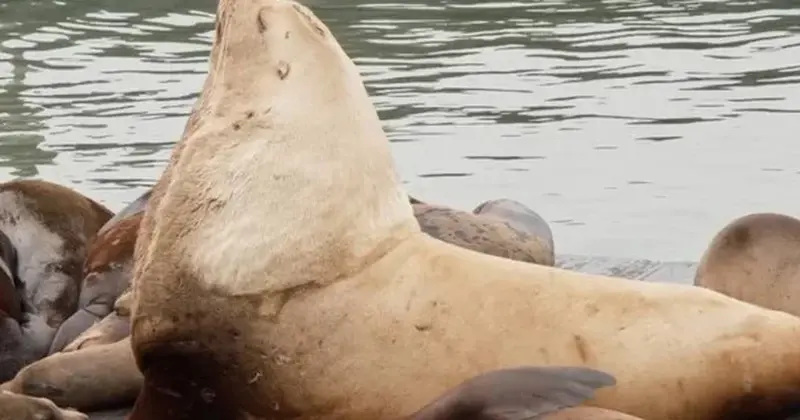
Giant "sea monster" unexpectedly appears in the harbor.
At Pier 39, one of San Francisco's most popular tourist destinations, the appearance of a giant "sea monster" is causing a sensation. This sea lion quickly attracted large crowds of locals and tourists who came to observe and take pictures because of its striking appearance compared to the surrounding sea lions.
This individual has been nicknamed "Chonkers." According to local media and experts from The Marine Mammal Center, Chonkers belongs to the Steller's sea lion species, the largest sea lion in the world . Its weight is estimated at around 680-907 kg, almost reaching 1 ton. Some visitors even compared Chonkers' size to "a Volkswagen," making the sight at the harbor even more remarkable.
Pier 39 is no stranger to the sight of sea lions basking on the floating docks. However, most sea lions that appear here are California sea lions, which are much smaller than Steller sea lions. Therefore, when Chonkers appeared, its massive size immediately created a striking contrast.
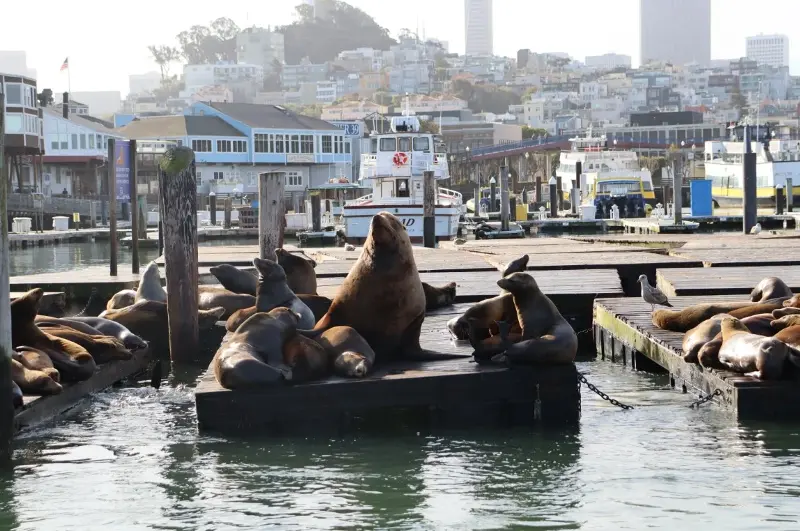
At Pier 39 in San Francisco, USA, the appearance of a giant "sea monster" is becoming a sensation. (Photo: Nat Geo)
In the captured images, Chonkers is nestled among a large group of sea lions, yet it's easily recognizable. Although simply resting like the other animals, its enormous size makes it an unwitting "star" of the harbor. Many passersby couldn't help but stop, take photos with their phones, and discuss the "sea monster" that had just appeared in the middle of a popular tourist spot.
According to AP, experts believe Chonkers may have swum from northern waters, off the coasts of states like Oregon or Washington, down to the San Francisco Bay area. This isn't entirely unusual, but the appearance of such a large Steller's sea lion at Pier 39 is still noteworthy.
An interesting detail noted by National Geographic is that Chonkers often appear on the floating pier in the morning, sometimes as early as 7:30 AM, and leave after a few hours to go into the water. This further encourages many tourists to arrive at Pier 39 earlier, hoping to catch a glimpse of this "heavyweight visitor."
Why do sea lions like to gather at Pier 39?
Pier 39 has long been one of San Francisco's iconic tourist attractions. The floating docks here are home to hundreds of sea lions, creating a lively and bustling spectacle that has attracted visitors for many years.
According to information from Pier 39, California sea lions began appearing in the area after the 1989 Loma Prieta earthquake. Initially, only a few individuals visited. However, their numbers quickly increased, and by January 1990, the sea lions had almost completely taken over the floating dock. After consulting with The Marine Mammal Center, the port authorities decided to allow them to remain.
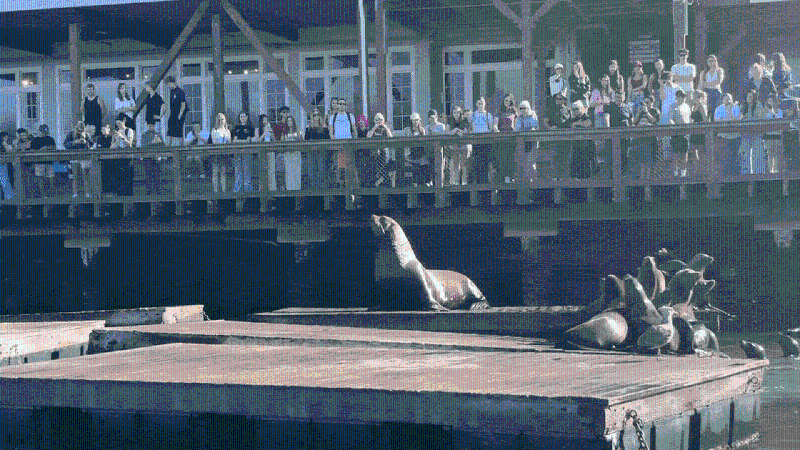
These floating docks are home to hundreds of sea lions, creating a lively and bustling spectacle that has attracted tourists for many years. (Photo: Nat Geo)
There are several reasons why Pier 39 is an ideal location for sea lions. The area is relatively safe, sheltered from large waves, has few predators, and is close to abundant food sources in San Francisco Bay. Fish species such as herring, anchovies, and rockfish are important food sources that help the sea lion population maintain its presence here.
Regarding Chonkers, experts suggest that the abundant food supply in the area may be one of the reasons it stayed longer than usual. Some local sources also indicate that this individual wasn't entirely a "stranger," as it had visited Pier 39 in previous years, but this time it attracted more attention because of its prolonged presence and the timing coinciding with a high volume of tourists.
The world's largest sea lion species.
Steller's sea lion is the world's largest sea lion species. According to The Marine Mammal Center, adult males can reach approximately 3.3 meters in length and weigh over 1,000 kg in some cases. Compared to the California sea lion commonly seen at Pier 39, Steller's sea lions have a significantly larger body, a flatter head, and a more powerful appearance.
This distinctiveness makes Chonkers stand out among smaller sea lions. However, experts emphasize that they are still wild animals. It's understandable that tourists are curious to observe them, but it's important to maintain a safe distance, refrain from feeding, touching, or disturbing the animals.
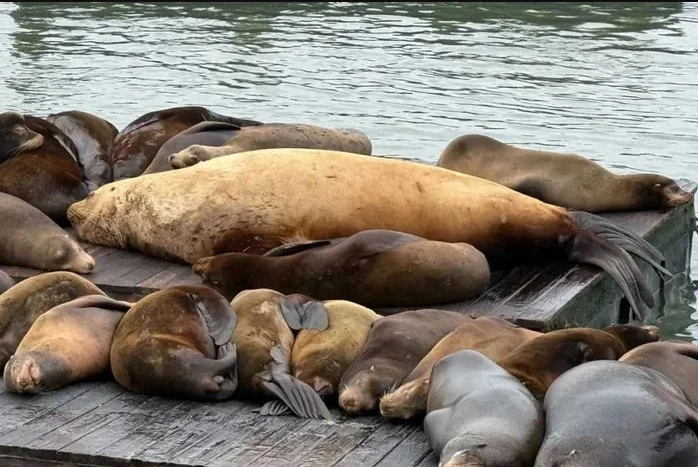
This difference is what makes Chonkers stand out among the smaller sea lions. (Photo: Nat Geo)
In the United States, marine mammals such as sea lions are protected by law. Harassing them, approaching them too closely, or disrupting their natural activities is discouraged and may even violate wildlife protection regulations.
It is unclear how long Chonkers will stay at Pier 39 and whether any more Steller's sea lions will appear. However, the mere presence of this nearly one-ton "visitor" is enough to keep San Francisco's famous harbor in the spotlight once again.
From a harbor already familiar with the sight of sea lions basking in the sun, Pier 39 now has a new "star." And for many tourists, the moment of witnessing a giant sea lion lying majestically in the middle of the harbor will surely be an unforgettable experience.
Nguyet Pham (Based on AP, Nat Geo, Axios)