


The wind blew in from the heart of the desert, not bitterly cold like in my hometown of Nghe An, but dry, light, and strangely astringent to the nose. Above, the sky was full of stars. So many stars that someone like me, from modern cities like Hanoi, felt as if I had just lost something after so many years living under electric lights.
Where the color blue tells its story.
Moroccans call the Sahara a sea. Indeed, standing on a sand dune in the Sahara and looking in all directions, one sees only endless golden waves. There is no shore. No green trees. Only sand, wind, and light. One only hears the distant howling wind, like the crashing waves against the shore.
But what surprised me most was that before reaching the sandy beaches, Morocco appeared like a soft, green silk ribbon draped across northwestern Africa. It was very different from the lands of South Africa, one of the homelands of diamonds, with its vast grasslands and farms offering a unique nature tourism experience that I had previously had the opportunity to visit.
The Turkish Airlines plane, famous for having the world's largest flight network by number of countries served, gently landed in Casablanca, Morocco, on a sunny afternoon in Istanbul. This largest city in Morocco wasn't as mysterious as I'd imagined from the famous movie Casablanca ; instead, it was modern, clean, with wide avenues opening out to the azure Atlantic Ocean.
Our first stop was the Hassan II Mosque. Standing at its base, I understood why it's considered one of the wonders of modern Islamic architecture, the second largest mosque in the world after the Shah Faisal Mosque near Islamabad. Its minara is the tallest mosque minaret in the world, reaching a height of approximately 210 meters.
The mosque's spire soars high, as if reaching for the vast, distant sky. Part of the structure's foundation is built over the sea. As the Atlantic waves crash against the rocky shore, the sound of the sea blends with the calls of prayer, creating an atmosphere that is both majestic and sacred. In Morocco, Islam is not just a religion; it is a way of life.
If Casablanca is the economic heart, then Rabat is the tranquil face of the country. The Moroccan capital is not as noisy and bustling as those often seen in Europe or America. Its avenues are shaded by trees. The pale yellow city walls stretch endlessly.
The entire North African country is covered in vast stretches of pale yellow houses, walls, and streets. The town of Oudaya overlooks where the Bou Regreg River meets the Atlantic Ocean. The salty sea breeze permeates every cobblestone street, even creeping into the deepest alleyways. In Rabat, one can sense a rare balance between the past and the present.
But that was just the beginning. Chefchaouen was the real surprise. I'd seen countless photos and videos of the "green city," but none could fully capture the feeling of stepping into its narrow alleyways, blanketed in a soft blue hue. Green walls. Green doors. Green steps. Green flowerpots. Even the light seemed tinged with a thin layer of blue. Some say that blue symbolizes the sky.
Some say it's the color of paradise in Jewish belief. Others simply believe that the color blue repels mosquitoes and soothes the heat of the Rif Mountains. Perhaps all of them are true. And perhaps no explanation is needed at all, because sometimes beauty is simply something to be admired, savored, and appreciated.
In the narrow alleyways, women sit weaving carpets. Old men leisurely sip mint tea. Children run past the verdant doorways. No one is in a hurry. Chefchaouen is like a moment of quiet amidst a world that moves too fast.
Along the layers of historical sediments
Leaving the verdant city, our journey took us back in time to Volubilis. Two thousand years ago, this was a thriving Roman city. The stone columns still stand there as witnesses to history.
The mosaic floors retain their original patterns, defying the ravages of time. The cobblestone paths still lead to the old square. Time may crumble the roofs, but it seems powerless against these story-telling stones.
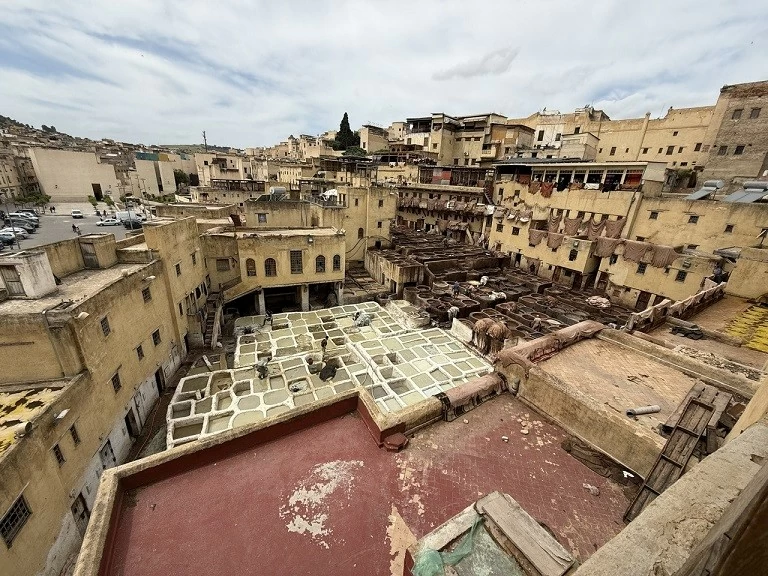
From Volubilis to Meknes and then Fes, Morocco unfolds like a chronicle in stone. If I had to choose the city with the most soul, I would choose Fes. Fes's Medina is a true labyrinth.
They say there are over nine thousand small alleys interwoven together. No signposts. No cars. No motorbikes. Only the sound of hammers striking the ground. The sound of scissors cutting leather. The cries of vendors. The smell of spices. The smell of mint. The smell of freshly baked bread. And the pungent smell of leather from dyeing workshops that have existed for hundreds of years. The craftsmen still use pigeons, turmeric, saffron, indigo, and other natural ingredients to dye each hide, just as their ancestors did centuries ago.
The world out there may be talking about artificial intelligence and robots, but Fes patiently holds onto his human hands. We rummaged through the craft villages to buy some leather goods to take home. A briefcase for work. A laptop bag. A few leather jackets, leather hats, and leather golf bags. All still had the earthy smell of real leather. Many items were surprisingly cheap.
The journey down to southern Morocco was a strange one. In just a few hours, the landscape changed constantly. Deep green cedar forests, like those I'd seen in Mongolia or the Taiga. The town of Ifrane, with its steep roofs, resembled a corner of Switzerland, as romantic as the land of luxury watches. The slopes of the Central Atlas Mountains. Then rocks. Red earth. Unfamiliar palm valleys. And finally, sand.
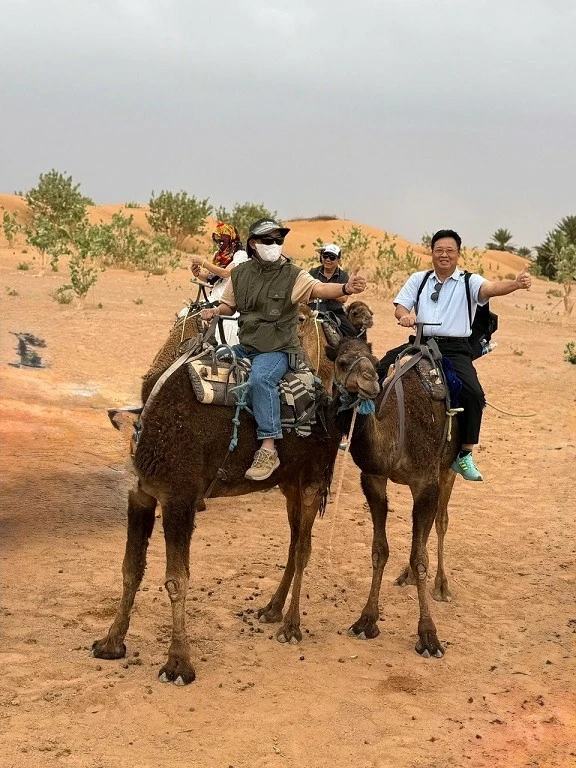
Upon reaching Merzouga, the vehicle was forced to stop. From then on, only camels remained. These animals, once known as the "ships of the desert," carried travelers slowly across the sand dunes. Each step seemed to transport one back centuries, to the time when caravans of merchants crossed the Sahara on the African Silk Road.
The camels here are dromedary camels, also known as Arabian camels, the greatest symbol of survival in the barren deserts of the Middle East, North Africa, and South Asia. The sunset descends quickly. The entire sea of sand changes color from yellow to orange, then red, then deep purple. It's a moment when every camera becomes useless.
The lingering echoes of a land
The following morning, leaving the Sahara, the group traveled through the Todra Gorge, the Valley of Roses, and the road of thousands of Kasbahs to Ouarzazate. It's no wonder this place is called the Hollywood of Morocco. Nature has created giant film sets. Kasbah Ait Ben Haddou appears like a city of terracotta rising from the semi-desert region. The honey-colored earthen walls change color with the sunlight. This place has also appeared in many famous films around the world.
Standing atop the Kasbah and looking down, I suddenly understood why cinema loves Morocco so much. The light here is incredibly beautiful. After descending from the mountaintop, Mr. Tho, a recently retired provincial official, and I both agreed that experiential tourism is a strength that local areas need to focus on.
Marrakech is a world of its own. If Fes represents depth, then Marrakech embodies the rhythm of life. Jemaa el-Fna Square begins to "wake up" at sunset. Storytellers, flutists, orange juice vendors, spice sellers, smoke rising from grills. Laughter, folk music, bargaining. The entire square is like a giant, curtainless stage. There, thousands of different people come together to create a very… Moroccan symphony. We hurried through the vastness of the square's night market.
On our last day, we visited the Majorelle Gardens. After days of wandering amidst rocks, sand, and ancient cities, the cobalt blue of the gardens offered a much-needed rest to our eyes. The painter Jacques Majorelle surely never imagined that the shade of blue he created would become a symbol of a nation.
I suddenly remembered Chefchaouen. The cedar forests. The palm valleys. The palace gardens. Amidst many people's imaginations of Morocco as a land of hot sand and desert, this country appeared like a soft, green silk ribbon embracing the vast Sahara.
Perhaps it is this very contrast that creates the special charm of Morocco, a country in Africa yet imbued with the colors of Arab and Mediterranean culture, with hints of European influence. A country with thousand-year-old cities that are still undergoing a powerful transformation. A country where, in just a few days, a traveler can journey from the Atlantic Ocean, through royal cities, across cedar forests, over the Atlas Mountains, sleep in the vast Sahara Desert, and then return to lush green gardens.
The trip has ended, but the memories of Morocco remain. Not just the blue of Chefchaouen, the yellow of the Sahara, but also the color of time etched onto every ancient stone, every market, every mosque, and every gentle smile of the people I met along the way.
Perhaps, for those who have once set foot in this country, Morocco is not just a destination, Morocco is a realm of memories!