


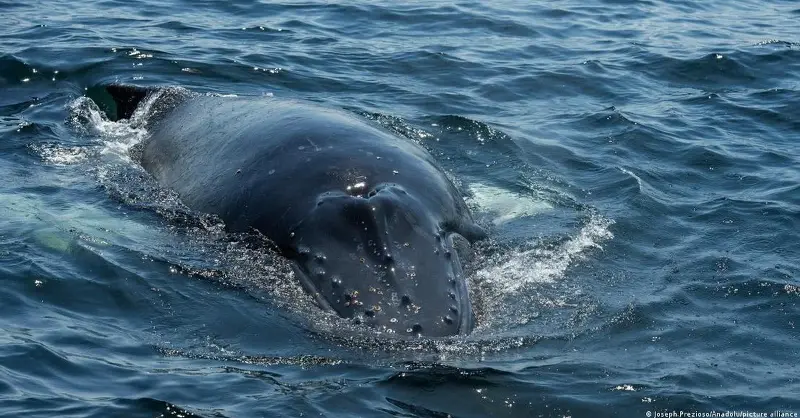
Scientists believe that climate change and changes in food sources may cause humpback whales to alter their traditional migration routes. - Photo: Joseph Prezioso/Anadolu/picture alliance
Two humpback whales have astonished scientists by undertaking a migration of over 14,000 km between Brazil and Australia, crossing numerous ocean basins and setting a new record for the longest migration distance ever recorded for this species.
Cristina Castro, head of the research team at the Pacific Whale Conservation Organization, said on May 27 that whales deviating from their usual migration routes is not uncommon, but this case is special because two individuals have moved between two breeding areas located tens of thousands of kilometers apart, something never before recorded.
To verify this journey, the research team analyzed more than 19,000 photographs of humpback whales taken between 1984 and 2005 in the waters off eastern Australia and Latin America. Using technology that identifies the unique pattern on the underside of the whale's tail – likened to a human "fingerprint" – the scientists identified two individuals that had been sighted in both Brazil and Australia.
One humpback whale was first recorded in 2007 in Hervey Bay, Queensland (Australia), before appearing off the coast of São Paulo, Brazil, in 2019. The other was discovered migrating in the opposite direction, from the waters of Bahia, Brazil, to Australia more than two decades later.
Previously, the record for the longest migration of humpback whales was a journey of over 13,000 km between the Pacific coast of Colombia and Zanzibar in the Indian Ocean.
Humpback whales are common in South America, particularly along the coasts of Brazil, Ecuador, Colombia, Chile, and Argentina. Each year, they typically migrate from the cold waters of the South Atlantic and South Pacific to tropical seas to breed.
These giant marine animals are also known for the complex "songs" emitted by the males, believed to serve a communication and mating purpose.
Researchers believe that climate change, altered ocean currents, and shifts in food sources may be causing some individuals to change their traditional migration routes. Such unusual journeys may also contribute to increased genetic diversity and create changes in the communication "tone" of humpback whale populations in the Southern Hemisphere.