



What do Rover, Saab, Infiniti, Maybach and Fisker have in common? They are all recently failed premium car marques in Europe. You might also consider Hyundai’s ailing Genesis brand, as well as the suspended Jaguar marque and the poor-performing Stellantis brands of Alfa Romeo and DS.
This boulevard of broken dreams is largely because while the potential rewards in the premium market are high (25 per cent of all sales yet 38 per cent of the profits), Europeans have traditionally rejected upmarket start-ups in favour of the established German brands of Mercedes-Benz, Audi and BMW. Honda, for example, has never attempted to launch its Acura premium brand in Europe, while Mazda’s proposed Amati line was killed off in 1992 before a single car had been sold.
Yet carmakers still get gooey-eyed at the potential of this tricky and fickle prize. The latest hubristic hopefuls are from China as its domestic manufacturers expand aggressively out of their moribund home market.
BYD’s Denza marque is just such an example; the name roughly translates as “rising power and momentum”. It was formed as a joint venture with Mercedes in 2010, but has been solely owned by BYD since September 2024.
The first Denza concept appeared in 2012, using a Mercedes platform and styling knowledge along with BYD’s expertise in lithium iron phosphate (LFP) batteries and electric drive, although the debut model wasn’t launched until December 2014.
At first new Denza model introductions were haphazard, with annual sales in China crawling from 2,800 in 2015 to 4,708 in 2021, but since 2023 sales have strengthened and reached 157,134 last year.
First arrival
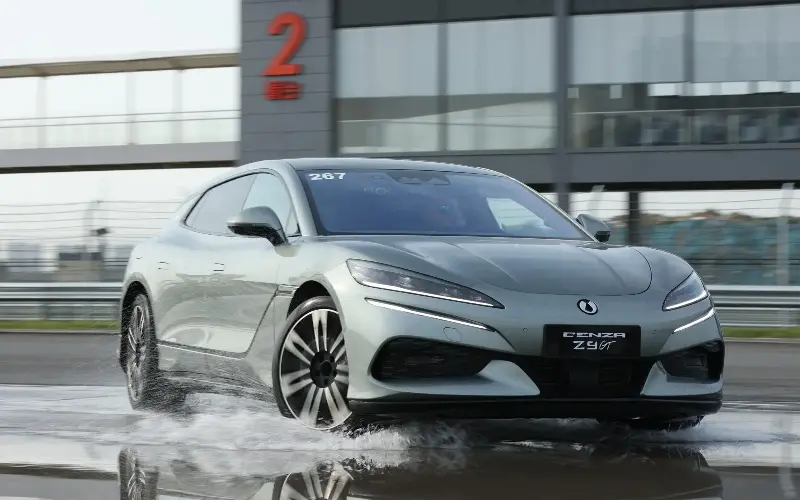
The first Denza Britons will see is the four-door Z9 GT, with a 1,140bhp/892lb ft three-motor electric drivetrain capable of a top speed of 149mph, 0-62mph in 2.7sec and a range of 372 miles from a 122.4kWh LFP “blade” battery. This range isn’t exceptional in a world where nearer 500 miles is the new benchmark. The price is expected to be about £115,000.
A plug-in hybrid (PHEV) version with a 2.0-litre petrol engine, three electric motors and a 63.8kWh battery will follow at about £100,000. It has a combined power output of 765bhp/763lb ft with only slightly lower performance than the EV.
It’s going to be some job persuading the public to take the Z9 GT seriously, especially when you learn that Chinese versions cost from £29,000 (although they have a different specification). How is the extra £75,000 justified?
While the Porsche Panamera is an obvious target for the Z9 GT hybrid, EV alternatives include the Porsche Taycan and closely related Audi e-tron GT, which have suffered as buyers shun expensive high-performance battery models.
Alternative to a Jaguar?
There’s also the new electric Jaguar, with the production version of the controversial Type 00 concept slated to go on sale early next year at about £120,000.
Should you ignore the Jaguar and buy one of these? That’s debatable, certainly not if you want to create a splash, since while the Denza style is neat but not showy it’s nowhere near as dramatic as European rivals.
Apart from the standard range of sponsorship (Inter Milan football and Racing 92 rugby teams, art shows and the like), Denza has also recruited Daniel Craig, the former James Bond actor, as a brand ambassador, who stares down from the posters with his ocean-blue eyes. So far, so premium…
What’s the Z9 GT like?
My drive of a Denza Z9 GT, which leads the invasion of Europe, was brief but highlighted significant shortcomings. In the Chinese-market configuration I tried, the air-sprung two-chamber suspension is very soft and the chassis dynamics are squidgy. The steering is too light, the carbon-ceramic disc brakes are strong but inconsistent, while it’s hard to locate functions on the huge touchscreen. The self-parking system is a pointless bit of theatre and it weighs 2,875kg, which might explain the so-so range and hard-pressed brakes.
On the plus side, there is plenty of room inside, it’s nicely trimmed and the seats are comfortable and supportive. It’s also fast, blisteringly so if you use all the performance. I had no chance to test the actual range, but the efficiency is claimed at three miles per kWh so it isn’t going to be great.
Other features include a radical rear-wheel steering system, which not only makes this large car feel quite agile in tight spots, but also permits a “crab walking” system which will self-park by pushing nose-first into a space then crabbing the back of the car around into the gap. It’s an arresting sight, but seems brutal on the rear tyres and is unlikely to be used by owners with any mechanical sympathy (or who can actually park).
At this year’s Beijing motor show BYD also announced a Denza Z Spider, which will be launched at the Goodwood Festival of Speed in July. It goes on sale this year and will be swiftly joined by coupé and shooting brake versions.
If nothing else, all the above demonstrates that BYD is serious about its assault on the premium market.
Ultra-rapid EV charging
Something that should also generate interest in the brand is a 1,000kW DC “flash charging” system, which is claimed to charge the battery from 10 to 97 per cent in nine minutes and add 250 miles of range in five minutes. It’s a mighty leap forward largely as a result of the robustness of the LFP chemistry and a new design which allows lithium ions to be more easily released (from the anode) and lodged (in the cathode). A new low-friction electrolyte helps speed the passage of ions, with a lower heat build-up. This Mk2 blade design also has a 2.5 per cent reduction in long-term degradation, so it will better withstand repeated ultra-rapid charging.
It sounds highly impressive, although a charging demonstration in China wasn’t quite all it seemed. Figures didn’t add up and at one point it seemed as if the charger was putting more energy into the battery than its total capacity. Nevertheless, it clearly works and there are already 5,300 flash-charger locations in China, with a commitment to have 20,000 by the end of this year. In the UK, BYD says it will have 300 flash chargers operating by the end of the year.
The Telegraph verdict
Last year Jaguar sold only 1,725 cars in the UK, Alfa Romeo 3,000, DS 1,015 and Genesis 1,225. Ineos sold 263 of its off-roaders, while Maserati sales totalled 372, so it isn’t hard to spot the losers in the premium battle.
The winners? Total Audi sales in 2025 were 111,115, BMW 122,723 and Mercedes-Benz (which has eschewed cheap hatchbacks) 89,265. Even Volvo sold 19,125 cars and Lexus shifted 16,454.
For newcomers to this premium market, these figures make sobering reading, especially for BYD when it looks at buyers’ antipathy towards the Korean-built Genesis or Chinese-built Lotus models. Denza can control its costs by sharing major components with cheaper BYD models. It can share dealerships and flash charging will appeal to high-mileage users, but you have to wonder whether there’s a place for the conservatively designed, high-tech Z9 GT in UK hearts.
Quite simply, it seems overpriced. Perhaps there is space in the market for abandoned Jaguar owners looking for a replacement, but not at six figures. Some folk won’t consider a Chinese car, but plenty do and Chery-owned Jaecoo’s 7 was the UK’s best-selling car in March.
Denza imagines it could sell the Z9 GT on technology (such as flash charging) before it trickles down to cheaper models. This strategy hasn’t really worked for rivals and Mercedes-Benz has abandoned it altogether; the most advanced EVs in its line-up are currently its cheapest models.
It will be interesting to watch. The spectre of a fleetingly rare cadre of owners, like fourth-rate Alan Partridge’s boring everyone about their high-tech Denzas, would be a sad fate for such a valiant initiative.