



I could not quite believe it when the black Volkswagen Golf pulled up outside our suburban semi in Reading. It was the mid-1980s, I was in my early teens and stone-washed jeans were the closest I got to exotica. My uncle was far and away the most stylish person I knew.
He was a lawyer working in Covent Garden, he had a flat in somewhere called Richmond and he owned a sleek separates hi-fi system. To top it all, he drove a Golf GTI. He took me around the estate and I was transported physically and metaphorically to a new world. A world called aspiration.
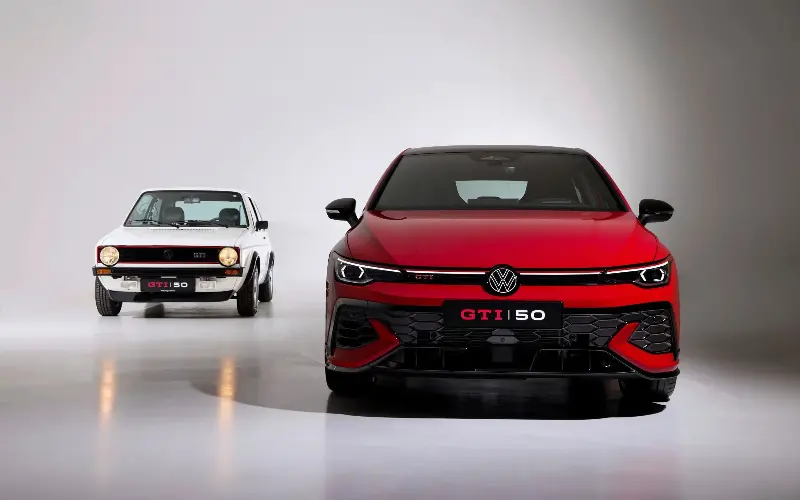
Fifty years old this year, the Golf GTI has reinvented itself eight times, weathered changing tastes and formats and remained an iconic presence in the Volkswagen line-up. But it came of age in the 1980s. It captured, even defined, the zeitgeist and never looked back.
Conceived by a secret and unofficial team of engineers at VW’s HQ in Wolfsburg, the original Golf GTI was launched in 1976. It was not the first hot hatchback, but it was the first to sell in numbers. A brilliant package of practicality, economy, lithe handling and responsive pick-up, it became the yardstick by which all rivals were measured.
An entire category grew from its coattails. By the time Margaret Thatcher went to the polls for a second time, winning a landslide in 1983, every mainstream manufacturer had introduced a tuned version of its family runaround. And the Mk2 GTI effortlessly moved the game forward compared with its predecessor.
How VW set the standard
The Golf was by no means the fastest gun in the West. The Peugeot 205 GTi had superior driving dynamics, while the Renault 5 Turbo was criminally quick. But the VW had three very Germanic qualities that elevated it above competitors. First, the build quality was a step apart. The doors made a resoundingly heavy clunk, the trim tended not to fall off and it felt like it had been honed from rock compared with some of its flimsier contemporaries (Fiat Strada 130 TC, anyone?).
Secondly, its styling was restrained and understated. Twin headlights, subtle red piping and a golf ball gear knob were about the summit of VW’s hot hatch excess. Compared with the fake wings, air dams and go-faster stripes of rival Renaults, Fords and MG-badged Austins, the Golf was resolutely conservative.
It was also expensive, typically retailing at between 10 and 15 per cent more than its mass-market rivals.
Classy yet classless
All of which meant it became a symbol of success but also a symbol of taste. The Golf GTI was somehow classy yet classless. It was the go-to car for junior City boys flush with their first bonuses yet was also respected by knowing petrolheads. It would hold its own at Ascot and Henley yet could grace the car park of Bejam without drawing unwarranted attention.
It offered owners the promise of naughtiness in a cloak of respectability. And the professional classes went mad for it.
One such owner was Ross Kemp, actor and soon-to-be Traitor, who remembers his GTI fondly. “I had a 16v GTI in silver with BBS alloy wheels; I’d been in various ads in the mid-80s and this was my reward. It was just a step up on the things I’d owned previously – a complete car really. Fun to drive, looked good, not too flash and a big boot. I look back and wish I’d kept it.”
Iconic advertising
This desirability was further fuelled by some of the most iconic advertising the UK had seen. Cinematic, long-form TV adverts showed glamorous protagonists going back to the one thing they could rely on – their Golf GTI.
The man who leaves the Monaco casino, penniless, having “put a million on black, and it came up red”, and “moved into gold, just as the clever money moved out”, to quote the dulcet voice-over. Things were looking up though… he still had his Golf GTI to see him through.
Or the divorcée, played by model Paula Hamilton in the 1987 “Changes” advert, throwing off the trappings of a failed marriage – the wedding ring, the pearls, the jewellery, the fur coat – only to exit the scene in the comfort of her beloved Golf. All underlined by the exquisite strapline “If only everything in life was as reliable as a Volkswagen.”
This was wit and understatement, pillars of VW’s advertising since the 1950s, through the lens of Thatcher’s Britain and it was an irresistible cocktail.
Nick Fox, the veteran adman who made those ads, remembers: “It was the Eighties, the era of the yuppie and Thatcherism and we were lucky, the ads hit the zeitgeist… they were totally on the button. But it was clever because it wasn’t overtly ‘come get me’ – you either got it or you didn’t. Confidence with self-deprecation. Good times.”
Shot by David Bailey and backed by the evocative Alan Price song, the “Changes” commercial summed up the 1980s in sharp detail: the mews house, the big hair, the shoulder pads, the supermodel with more than a hint of Princess Diana. Above all the attitude.
On the face of it, reliability seems an odd way to market a hot hatchback, but the ads hit on a truth about the cars we love: they become an anchor in our lives, a safe space, an enabler that gives us the confidence to face life. Our heroine gets in the car, the wipers clear the rain from the windscreen and she taps the steering wheel affectionately. You know she will be OK.
As Fox reflects: “That ad in particular was totemic and seemed to represent the times perfectly… you warmed to the protagonist. For all the aspiration there was a grit there… she was a fighter and you knew she would win through, as would the car.”
Buying advice
The GTI never looked back from those heady days and the stardust it sprinkled on the marque helped propel Volkswagen from niche player to volume winner. Five decades and eight generations later it still has that lustre and there is a version for every taste and every budget.
If you want the most modern incarnation, the 50th-anniversary edition is the most powerful yet and won’t give you much change from £50,000.
If you’re a purist then you’ll be looking for a Mk1 or Mk2 (the chassis dynamics of the second generation being more highly prized) for less than half that money, while the Mk3 and Mk5 look good bets to grow into “modern classic” status for very little outlay.
Choose well and you won’t be disappointed. That teenager from Reading wasn’t. He eventually enjoyed the taut poise of a Mk2 for several years before buying something infinitely more boring.
As Kemp puts it: “There’s something about that GTI badge, a kind of magic – everyone should own a GTI at least once in their life.”