



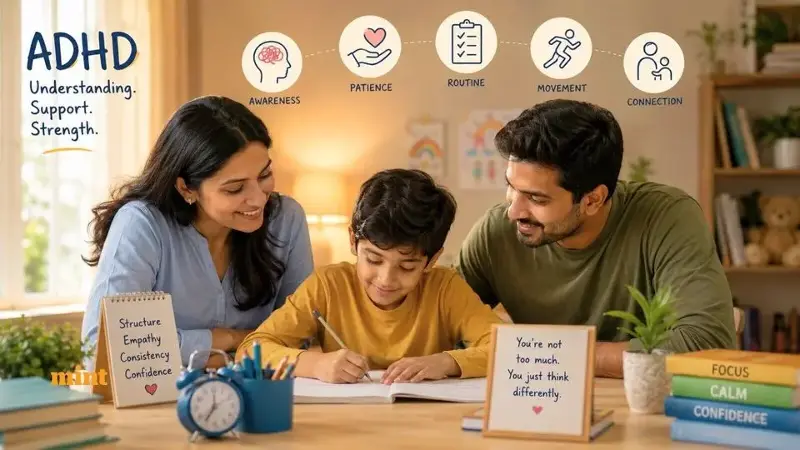
ADHD (Attention-Deficit/Hyperactivity Disorder) is one of the most misunderstood conditions in childhood development. It is also one of the most commonly missed. Parents across India are navigating this challenge daily, often without adequate guidance.
According to a 2020 study, the majority (69.3%) of the ADHD-positive children in India live in a joint family. They belong to the lower or lower-middle class.
We spoke to three experts about early signs, damaging parenting patterns and daily routines that genuinely help. Their answers were detailed, compassionate and, at times, uncomfortable to read.
Signs Parents Miss
All three experts started with the same observation. ADHD symptoms are frequently mistaken for ordinary childhood behaviour. That misidentification causes enormous harm over time.
Devina Kaur, Mental Health Educator and Certified NLP Coach, pointed to one pattern that consistently confuses parents. A child with ADHD may focus deeply on activities they enjoy. The same child will completely lose focus on activities they find boring.
Parents interpret this as the child choosing when to pay attention. That interpretation is incorrect. Children with ADHD genuinely cannot regulate their attention the way other children can.
Kaur also flagged emotional outbursts as an early and commonly-missed signal. Children with ADHD often get upset or frustrated over seemingly small things.
“Parents often see these as overly stubborn, although they are actually linked to difficulty managing emotions,” she said.
Forgetting instructions, losing school items, leaving tasks unfinished and appearing inattentive are also early indicators. These are almost universally dismissed as carelessness. They are not.
Archana Singhal, Counsellor, Family Therapist, and Founder of Mindwell Counsel, emphasised consistency as the most overlooked diagnostic clue. The behaviour in ADHD children is not deliberate. It is repetitive and persistent across different situations and settings.
These children can start tasks but struggle to complete them. They interrupt conversations. They lose things. They seem emotionally volatile. At home, they are often called stubborn, lazy, or attention-seeking. None of those labels is accurate or helpful.
Singhal added an important nuance. A quiet, daydreaming child who seems distracted may have inattentive ADHD. This type is particularly easy to miss.
“Children's thoughts may be hyperactive when the body is not; they may not always look hyper, but they may seem distracted, daydreamy or spacey. The sooner we know what's up with the kids, the better, and the less of those critical, unhealthy, and self-esteem-destroying remarks we make,” she said.
Surg Commodore Dr Sunil Goyal, Senior Consultant in Psychiatry at Sarvodaya Hospital, Faridabad, reinforced this point. Inattentive ADHD is especially common in girls and is frequently overlooked entirely. These children appear absent-minded rather than disruptive. They are intelligent and eager, but struggle with simple instructions and completing tasks.
Sleep difficulties, emotional outbursts, and rapid mood changes are also early warning signs that families tend to normalise. The key question, Dr Goyal noted, is consistency. If these patterns are affecting confidence, relationships, and functioning at home and school, a professional evaluation is warranted.
Parenting Tips
All three experts were direct about this section. Many damaging parenting patterns come from good intentions applied in the wrong direction.
Devina Kaur identified consistent criticism as the single-biggest driver of low self-esteem in ADHD children. Telling a child repeatedly that they are careless, unfocused, or not listening plants a seed of inadequacy that grows over time.
Comparing an ADHD child with a sibling or classmate is equally damaging. These comparisons feel motivating to parents. To the child, they communicate only one message: I am not good enough.
Archana Singhal observed that many parents would make the mistake of correcting behaviour rather than addressing emotions first. Questions like "Why can't you just concentrate?" or "Your sister can do this, why can't you?" create shame and confusion in children who are already working very hard internally.
Over time, these children internalise a belief that they are fundamentally bad or broken. Excessive punishment, yelling, and constant correction significantly worsen emotional dysregulation.
Children with ADHD are already struggling with impulse control and executive functioning. They need guidance and structure, not a relentless stream of corrections.
Singhal also flagged the opposite extreme as harmful. Rescuing a child from every minor difficulty prevents the development of confidence and resilience. Both over-correction and over-protection damage the child in different but equally real ways.
Dr Goyal brought a clinical lens to the same issue. Treating ADHD behaviours as character flaws rather than neurobiological challenges is the root of most parenting errors. Constant pressure to try harder, excessive academic focus and harsh discipline increase anxiety and emotional withdrawal. Inconsistent parenting is another significant problem.
ADHD children need structure, predictability, and calm communication above almost everything else. Dr Goyal also highlighted excessive screen exposure as a growing concern. Overstimulation worsens irritability, sleep problems, and attention difficulties in measurable ways.
Recommended Daily Habits
Devina Kaur recommended spending 30-40 minutes daily with the child in a calm, correction-free environment. This simple practice builds emotional security and confidence over time.
A fixed daily routine covering waking, meals, homework, play and sleep reduces overwhelm significantly.
“Daily meditation and mindfulness, including the practice of martial arts, can be helpful,” she added.
Archana Singhal emphasised the role of physical activity as a powerful regulator of focus and emotion. Outdoor play, sport, dance, and physical breaks during the day make a measurable difference.
One-on-one connection time of 15 to 20 minutes daily should focus on the child as a person, not on achievements or behaviour. Praising effort rather than outcomes builds genuine self-esteem over time. Teaching children to name and recognise their emotions is another valuable long-term habit.
Dr Goyal stressed the importance of sleep and physical exercise as foundational to ADHD management. Poor sleep makes everything worse. Regular exercise improves focus, mood and behaviour in consistent and documented ways.
He also encouraged parents to identify and nurture strengths outside academics. Many children with ADHD are highly creative, energetic, and imaginative. Confidence grows when they feel valued in sport, music, art, or leadership roles.
“Long-term ADHD management works best when families stop looking at it only as an academic issue and focus more on the child’s overall emotional well-being and confidence. Children with ADHD usually thrive with structure and predictability. Children with ADHD usually do better when their day follows a predictable routine. Regular timings for sleep, meals, studies and play can help them feel more settled and less overwhelmed.”
The experts agreed on one final point. Managing ADHD is not about making the child appear normal. It is about helping them feel understood, emotionally secure, and genuinely confident in exactly who they are.