



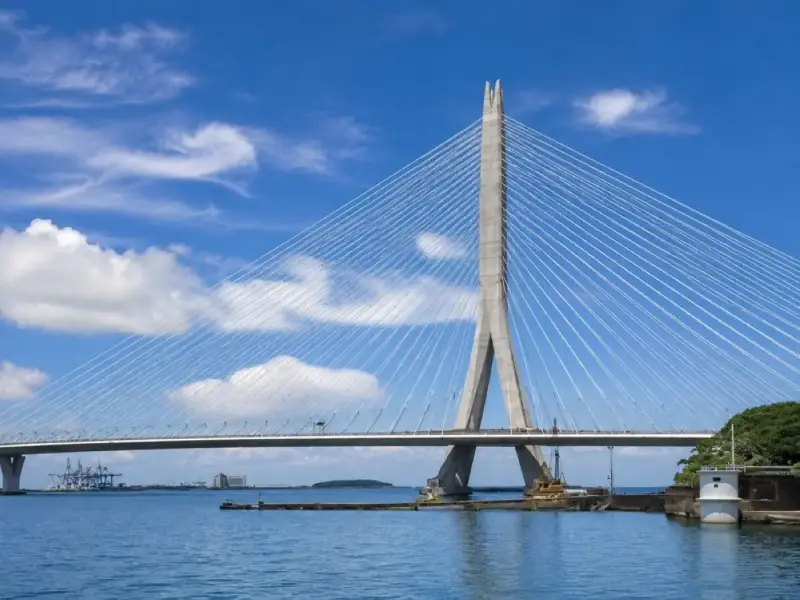
NEW TAIPEI CITY, Taiwan — I stood at the edge of the Tamsui River estuary and took in the newly opened Danjiang Bridge, a structure that offered more than an impressive display of engineering and design.
The Danjiang Bridge is impressive for its scale and design, but what caught my attention as a Filipino visiting Taiwan was something more familiar: the role of a bridge in bringing communities closer together.
This was my first close look of Danjiang Bridge, Taiwan’s first cable-stayed bridge and one of the country’s major infrastructure projects. It is also the world’s longest single-tower asymmetric cable-stayed bridge, a distinction evident in its unusual design and massive scale.
Yet its significance is not limited to engineering.
The bridge connects Tamsui District on the eastern bank of the Tamsui River with Bali District on the western side of the estuary. Its opening is expected to shorten travel between the two districts and ease traffic.
For a Filipino, the idea is easy to relate to.
In the Philippines, bridges are closely associated with connecting communities separated by rivers and seas. From the San Juanico Bridge linking Leyte and Samar to smaller bridges serving communities across waterways, bridges are an important part of life in an archipelago.
Danjiang Bridge serves much the same practical purpose, although its design gives it a character of its own.
The bridge’s design was inspired by the movements of performers from Taiwan’s Cloud Gate Dance Theatre. Its single curved tower rises about 200 meters above the water, while its 450-meter main span stretches across the estuary toward Bali District.
From the riverside, the mast and cables create a distinctive profile. But depending on where one stands, the bridge can also appear to blend naturally into the surrounding landscape.
Its design also incorporates the needs of people using the area beyond those simply crossing the river. Aside from lanes for cars, motorcycles and buses, the bridge includes pedestrian and cycling paths. Space has also been provided for the planned extension of the Danhai Light Rail system across the Tamsui River.
For me as a Filipino journalist accustomed to covering infrastructure projects in the Philippines, this offered a slightly different perspective.
Infrastructure projects at home are often discussed in terms of cost, construction schedules, traffic, connectivity and their effects on nearby communities. At Danjiang, the bridge is also something people come to see.
The riverfront provides visitors with views of the structure, the estuary and the communities on both sides. The bridge, in that sense, has become part of the landscape even as it serves its practical purpose.
Bridges may differ in design, size and purpose, but the basic objective remains the same — making it easier for people to travel, work, visit and maintain ties with communities on the other side.
Danjiang Bridge took decades to reach completion.
It was first proposed in 1998 and went through environmental reviews, design changes and several unsuccessful tenders before construction finally began in February 2019.
The project was based on a design by the late British-Iraqi architect Zaha Hadid and her firm, Zaha Hadid Architects, with Kung Sing Engineering Corp. serving as the contractor.
After years of construction and engineering challenges, the bridge officially opened to traffic on May 12, 2026.
Standing beside the Tamsui River, I found the bridge easier to appreciate as a connection between communities — a purpose that felt familiar to me as a Filipino.
Danjiang Bridge is a major engineering project, a transportation link and a new landmark in northern Taiwan. At the same time, it is becoming part of the place it was built to connect. Beyond its size and design, it serves a simple and familiar purpose — bringing people and places on opposite sides of the water closer together.