



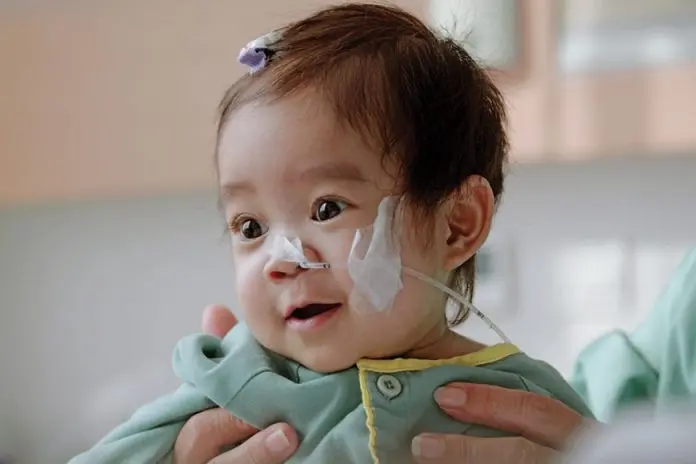
Hanoi, Feb. 11 -- By 11 months old, Truong Thien Di weighed just 5.3 kilograms. Born with biliary atresia, she spent much of her early life in hospital. As her condition deteriorated, the question was no longer whether a transplant was needed, but whether her fragile body could survive one.
Extreme Fragility in Infant Liver Transplantation
In modern medicine, liver transplantation in infants is no longer rare. The greatest challenge emerges when extreme physiological fragility compounds at a young age.
Soon after birth, Di was diagnosed with biliary atresia. A Kasai portoenterostomy at three months failed to stop disease progression, as fibrosis, persistent jaundice, and severe malnutrition continued to weaken her fragile body.
By October 2025, at 11 months of age, Di weighed only 5.3 kilograms. International studies consistently show that infants weighing under 6 kilograms face significantly higher surgical and postoperative risks than other pediatric transplant recipients. With options narrowing, her family turned to Vinmec Times City International Hospital, hoping for a liver transplant.
"This is the lowest-weight pediatric patient we have ever performed a liver transplant on at Vinmec," said Associate Professor Dr. Le Van Thanh. With experience from hundreds of complex liver transplant cases, Dr. Thanh - Deputy Chief Medical Officer for Surgery at Vinmec Healthcare System - directly performed the operation on the child.
A Critical Decision and a Marathon Operation
After multidisciplinary review, Vinmec's transplant team made a critical decision: Di's biological mother would serve as the donor, balancing adequate liver volume for the child with absolute donor safety.
"I am simply giving back the life my child deserves," Di's mother said.
The more than 12-hour operation required exceptional expertise to reconstruct the portal vein, hepatic artery, and bile duct. The transplanted liver began to function, but the fight was far from over.
According to Dr. Le Van Binh from the Intensive Care Unit, postoperative care extended far beyond advanced medical equipment. Every injection, medication dose, nutritional intake, and therapeutic adjustment was carefully calibrated to the child's fragile physiology.
In the days that followed, recovery depended on an intensely individualized care plan. Gradually, the child stabilized, began to breathe more comfortably, and started to gain weight, showing small but significant signs of progress.
Clinical Depth, Technology, and a Regional Vision for Transplant Care
Years of treating complex transplant cases have built a level of clinical capability that now defines Vinmec's role as a national referral center for high-risk paediatric liver transplantation.
At the forefront is Dr. Le Van Thanh, a leading figure in Vietnam's liver transplant program, whose work extends beyond the operating room to sharing surgical techniques and clinical protocols with multiple centers throughout Southeast Asia.
This human expertise is reinforced by advanced technology. Cutting-edge laparoscopic systems with ICG fluorescence imaging (Indocyanine Green Imaging) allow precise visualization of biliary anatomy and vascular structures in the liver without the need for repeated X-ray imaging. Meanwhile, modern anesthesia and intensive care enable real-time monitoring, precise control of vital parameters, and timely intervention.
Vinmec also meets some of the world's most stringent international standards, including JCI, AABB, UCARE, ADCARE, and CAP, supporting safe and highly accurate transplant care.
These strengths are positioning Vinmec as a trusted regional destination for liver transplant care.