



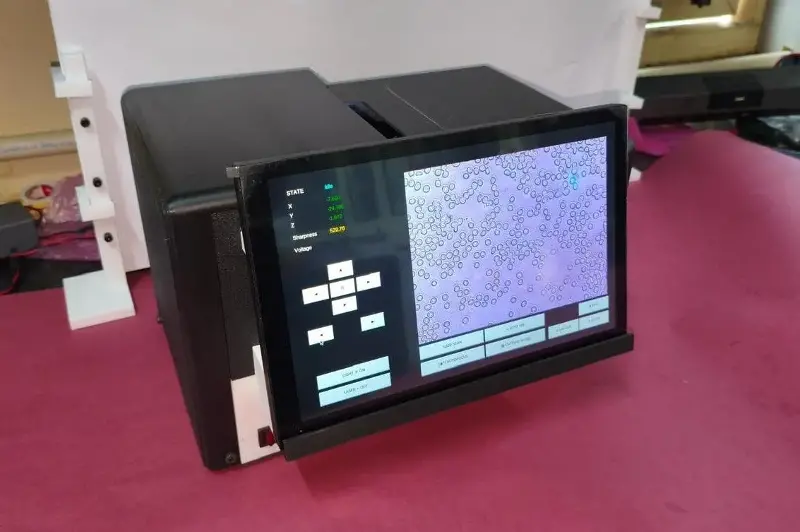
India, May 26 -- Researchers from the Department of Biotechnology and Medical Engineering at National Institute of Technology (NIT) Rourkela have developed an AI-enabled autofocusing technology that can improve microscopic imaging for biomedical diagnostic applications. The technology is capable of producing rapid, accurate, and repeatable results with minimal human intervention.
Developed in collaboration with Glowvista Instruments, a startup incubated at NIT Rourkela's Incubator centre (FTBI), the research team has secured a patent titled, "A Method for Autofocusing in Optofluidic Microsystems and Processes" for the technology.
Developed at a cost of Rs 1.20 lakh, in lab-scale testing, the system showed accurate results in detecting Acute Lymphoblastic Leukemia (Blood Cancer), malaria, and Complete Blood Cells counts through blood cell classification (5-class and 7-class categorisation).
Speaking about the developed technology, Dr Earu Banoth, Assistant Professor, Department of Biotechnology and Medical Engineering, NIT Rourkela, and Founder & Director (Non-Executive) of Glowvista Instruments said, "Our target is to develop a simple handheld system that should work as effectively as imported automated microscopy technology with precise information. Further, the system should be extended for various applications, unlike Flow Cytometers and Imaging Flow Cytometers."
The system has been developed with research grants from the Anusandhan National Research Foundation (ANRF), Department of Science and Technology (DST), and Department of Biotechnology (DBT), Government of India.
The developed technology has potential applications in Biomedical diagnostics and disease detection; Digital pathology and tissue imaging; AI-assisted microscopy and automated imaging; Point-of-care healthcare devices; Microfluidic analysis and biofluid monitoring; Biomedical and Life sciences research; Smart laboratory automation; Portable and remote diagnostic systems.
Speaking about the next steps of this research, Prof. Banoth said, "We are extending our work to develop complete ground truth data as well as scale up the work for deployment at various locations for field testing and to obtain feedback from diagnostic centres and research laboratories. The data will be used for further approvals towards developing a market-ready product, and we look forward to its market launch. At present, we are looking for funding support from both the research and startup sides to scale up the work."