


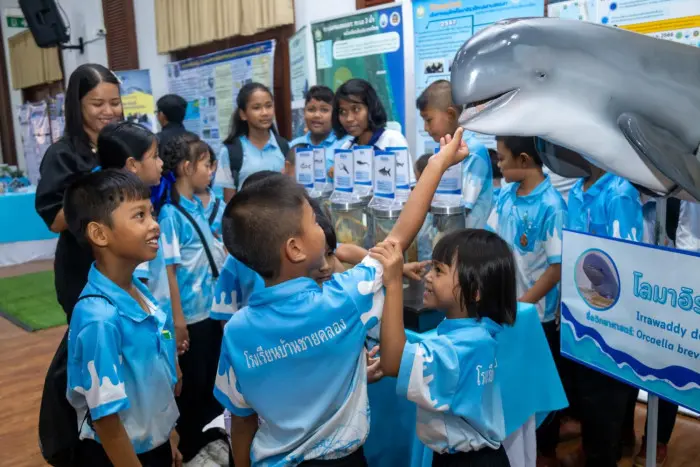
On the shores of Songkhla Lake, the survival of endangered Irrawaddy dolphins is tied to the livelihoods of the people who share their habitat.
With an estimated 10-14 dolphins remaining in the lake in 2026, Thaksin University's Phatthalung campus has joined state agencies, the World Bank, businesses, civil society groups and local fishing communities to launch the "Irrawaddy Dolphin and Community" initiative.
The project covers 60 fishing communities -- 32 in Songkhla province and 28 in Phatthalung -- with a focus on making conservation compatible with the economic needs of residents who depend on the lake.
Assoc Prof Nathapong Chitniratna, president of Thaksin University, said protecting the dolphins required a broader understanding of the relationship between the environment, society, culture, economic security and quality of life.
"The important concept is to move beyond seeing dolphins, people and the lake separately, and instead recognise the relationships within the entire system," he said.
Fishing communities depend on the lake's natural abundance for their livelihoods. As aquatic resources decline, household incomes come under pressure, making it difficult for residents to sustain traditional occupations.
Assoc Prof Nathapong said alternative livelihoods were essential to conservation, providing communities with more ways to earn an income while reducing pressure on natural resources.
"Creating alternative occupations from natural resources is not simply about increasing income. It is also an important mechanism for giving communities choices while reducing pressure on resources and supporting lake conservation," he said.
Assoc Prof Samak Kaewsuksaeng, the university's vice-president for research and innovation and project leader, said the initiative draws on the university's research, technology and innovation to support new livelihoods alongside community participation.
Community Implementing Committees (CICs) are central to the approach, giving residents a role in identifying local problems, expressing their needs and designing activities that combine conservation with income generation.
The model aims to ensure livelihood opportunities reflect the circumstances of individual communities rather than impose a single solution across the lake.
Chawanon Kalaya, a fisheries biologist at the Marine and Coastal Resources Research Centre under the Department of Marine and Coastal Resources, said local participation was essential to protecting the dolphins and developing sustainable occupations.
Communities are exploring a range of alternatives, including recirculating aquaculture, laying-hen farming, rubber-thread bag weaving, coastal rice cultivation, preserved catfish production, hydroponic vegetable growing and stingless-bee farming.
Diversifying income sources could reduce households' dependence on fishing while allowing residents to build on their skills and local resources.
"The initiative also seeks to connect community products with wider markets, helping turn new occupations into more sustainable sources of income," he said.
Mr Chawanon said locals should participate in shaping livelihood activities, supported by research and innovation from Thaksin University and knowledge from the communities themselves.
Conservation efforts also extend to children and young people through the "Songkhla Lagoon Gyotaku" programme, which uses creative activities to introduce biodiversity, lake ecosystems and Irrawaddy dolphins.
Participants work with discarded fabric and old fishing equipment to produce artworks, transforming materials that might otherwise become waste into tools for environmental learning.
The activities are intended to help younger generations understand the lake's ecological importance and develop a shared sense of responsibility for its future, he said.
The initiative reflects a wider recognition that wildlife protection cannot be separated from the well-being of communities living alongside vulnerable species.
Without viable livelihood options, residents may remain heavily dependent on the same natural resources conservation efforts seek to protect.
By combining community-led planning, research and alternative occupations, the programme aims to support both environmental recovery and economic resilience around Songkhla Lake.
For Mr Chawanon, the goal is to build a future in which conservation and community welfare reinforce one another.
"This must not be the responsibility of just one side.
"It is about building a shared future: the Irrawaddy dolphins can survive, the lake can endure and people can live well," he said.