


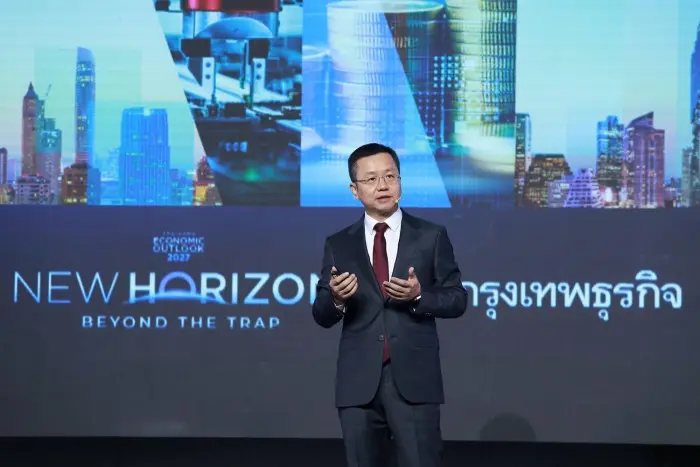
Flexible AI infrastructure, data sovereignty and home-grown talent are the three key priorities required to make Thailand a regional AI hub, says Huawei Thailand.
"AI is advancing rapidly, with increasingly powerful large language models and intelligent agents capable of handling complex tasks," said David Li, chief executive of Huawei Technologies (Thailand) Co, speaking at a recent economic outlook seminar held by Krungthep Turakij.
However, many businesses still struggle to connect these developments with their daily operations, he added.
"Thailand's AI usage is growing significantly. AI token consumption on Huawei Cloud Thailand increased 185-fold between April and September, while September consumption was approximately 30 times that of January 2026," he said.
Nevertheless, Thailand still trails regional peers, including Singapore, Malaysia and Vietnam, in broader AI adoption indicators.
This gap highlights an opportunity to move beyond individual AI tools and isolated experiments towards wider adoption across business operations and industries.
Mr Li said five layers underpin an AI-driven economy: energy, data centres, connectivity, chips and models, and industry applications.
Thailand has made progress in several areas, supported by its electricity infrastructure, expanding data centre investment and advanced telecommunications networks, including 5G. However, the concentration of data centres in certain locations creates challenges in local power supply, while the country remains less developed in advanced semiconductor technologies and foundational AI models.
Rather than competing in every part of the global AI supply chain, Mr Li said Thailand should strengthen its existing advantages and focus on capabilities that can support long-term growth.
With new AI models continually challenging established players, Mr Li warned that dependence on a single provider could limit businesses' ability to adopt better technologies.
He encouraged organisations to consider open-source models, neutral platforms and flexible deployment options, including on-premises systems and domestic or overseas cloud services, depending on data security and operational requirements.
He cited a major Chinese bank with an AI research team of about 100 people that prioritised the speed of integrating newly released models over model size or performance.
The example underscores the importance of building adaptable AI systems rather than investing heavily in technology that could quickly become outdated.
DATA SOVEREIGNTY
Mr Li said that data and business knowledge will become much more important sources of competitive advantage.
He raised concerns over how companies can protect proprietary knowledge and sensitive information shared with AI systems from being accessed by others.
He highlighted three priorities: data sovereignty, data governance and data monetisation -- retaining control over data, ensuring its reliable management, and creating business value from it.
He encouraged businesses to invest in data platforms and governance rather than focusing solely on AI software and computing infrastructure.
Mr Li highlighted DIMAK, Huawei's AI Engineering Framework introduced at Huawei Connect 2026 in Shanghai, as a way to integrate AI into business operations.
It focuses on connecting AI models with reliable data, existing systems and business workflows to deliver measurable results, rather than deploying AI as a standalone technology.
LOCAL TALENT
Mr Li also stressed the need to develop Thailand's AI talent through practical experience rather than relying solely on experienced specialists or graduates from leading universities.
He cited Alibaba's founding by Jack Ma and 17 others in 1999, as well as DeepSeek founder Liang Wenfeng's emphasis on fundamental skills, creativity and passion.
Mr Li urged Thai businesses to invest in employees, particularly younger professionals, by giving them opportunities to experiment and develop AI applications through real projects.
He said that Thailand's AI progress towards 2027 will depend not only on investment, but also on businesses' ability to translate technology and local talent into productivity gains and economic value.